


About
History is written by the victors
Or so the saying goes. Many people attribute it to Winston Churchill, but it turns out he was borrowing from writers who came before him. Even the famous line about who writes history has a muddled history of its own.
So who writes the stories about you and me and the people we love?
Every life storyteller eventually discovers the same thing. Stories are not fixed objects. They are interpretations.
A person tells you about an event. Their sibling remembers it differently. Their spouse saw something else entirely. The newspaper reported another version. The official records tell yet another story. Fifty years later, the family has polished the rough edges, forgotten certain details and elevated others into legend.
Memories drift. They soften. They rearrange themselves. We don’t just forget things. We polish them. We round the corners off. And the next generation inherits the polished version.
It happened in my own family.
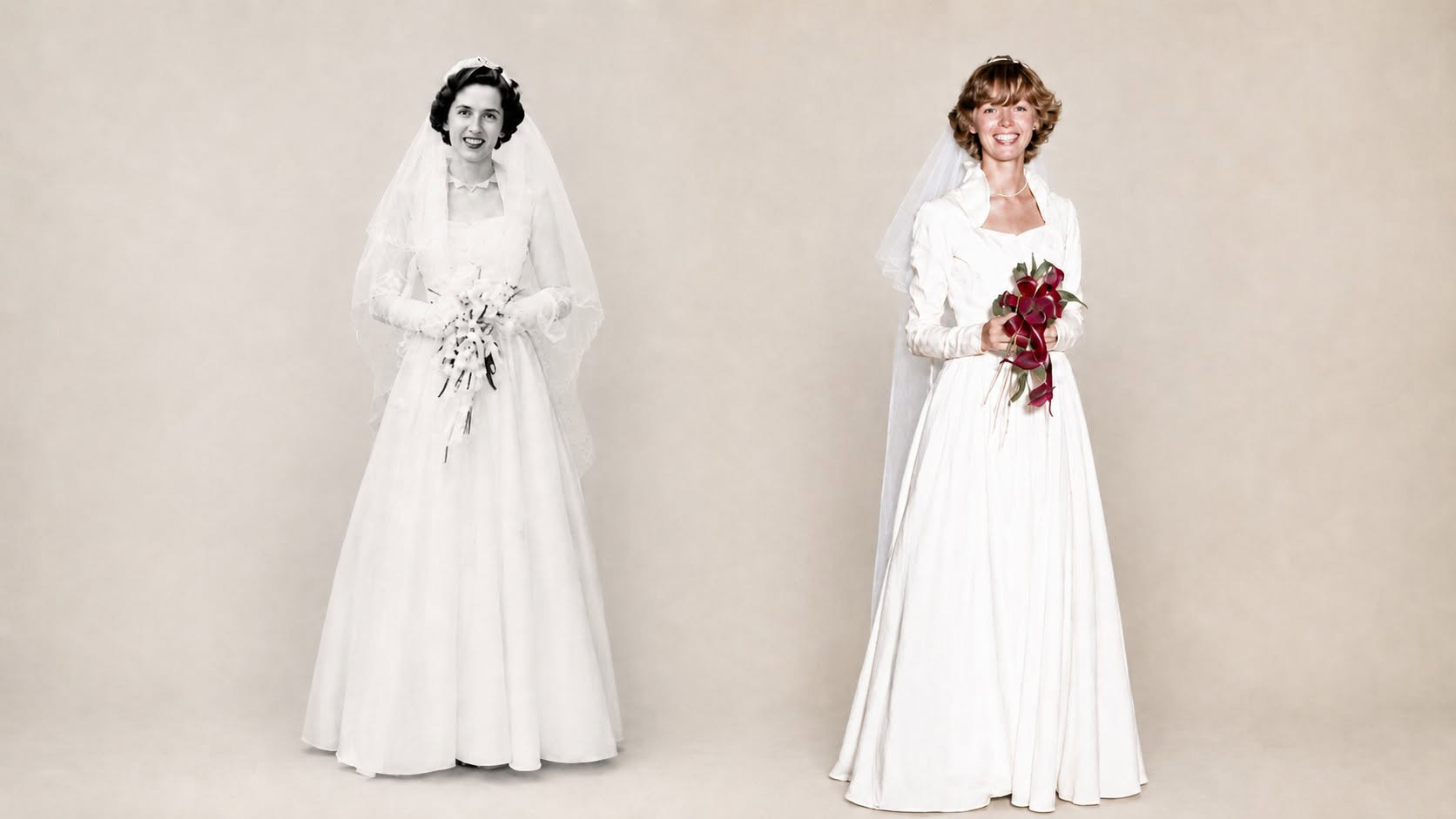
The Pearls
I had never seen this photograph of my mother until I sat down and interviewed a relative. It had been in a box, in someone else’s house, for decades. This is what happens when you start asking.
Both of my parents, separately and on different occasions, told me that my mother wore a string of pearls on her wedding day. So when I got married, I wore my mother’s wedding dress, and I wore those pearls. I thought I was carrying her wedding day forward into mine.
Here we are. My mother, Robyn, on the left. Me on the right. Same dress. She wore it first; I wore it second.
Look at her necklace. Those are not pearls. My mother wore a different necklace altogether on her wedding day. But both of my parents, separately, had told me she wore pearls, so when my turn came I wore pearls too. I believed I was carrying her wedding day forward into mine, down to the last detail. The detail was wrong. Two people who were there, who loved that day, remembered it the same wrong way, and I inherited their version without ever questioning it. I still wore the pearls. I would wear them again. They belong to the story my parents told me, even though they were never part of the day itself.
The twenty-one inch waist
That is not the only thing this photograph quietly corrects.
My mother always told me her waist was twenty-one inches when she married. That was the story. She used to say it almost as a warning. You will never fit into my dress, my waist was twenty-one inches.
Look at her. That is not a twenty-one-inch waist. That is a perfectly normal waist on a young woman in the 1950s. And the dress fitted me just fine.
I am not telling you this to catch my mother out. The twenty-one-inch waist was never really a measurement. It was a story she told about her younger self, and it survived because it was vivid and a little bit strange. That is how memory behaves. The odd, specific details are often the ones that last. And sometimes they are the only memories a family has left, because nobody wrote anything down.
What this taught me about life stories
When you sit with someone and record their life story, you are not uncovering a single objective truth. You are capturing their truth, their memories, the meaning they made from what happened.
Some of the life stories I have recorded were finished only weeks before the storyteller died. Without those conversations, everything they told me would have gone with them. What I do is quite different from writing history books or newspaper reports. I am preserving memory. And memory has its own value, even when it is imperfect.
One of the fascinating tensions in life story writing is that people often tell two stories at once. There is the factual sequence of events, and there is the story they have been telling themselves about those events for decades. Sometimes those two things align. Sometimes they don’t. Both belong in the record, because both are true in their own way.
Whose version will be remembered?
Perhaps the richest answer is to preserve as many voices as possible, before they disappear.
If there is someone in your life whose story you want to capture, I can help you do that.
We sit down. We talk. I write it.
You keep the story.